

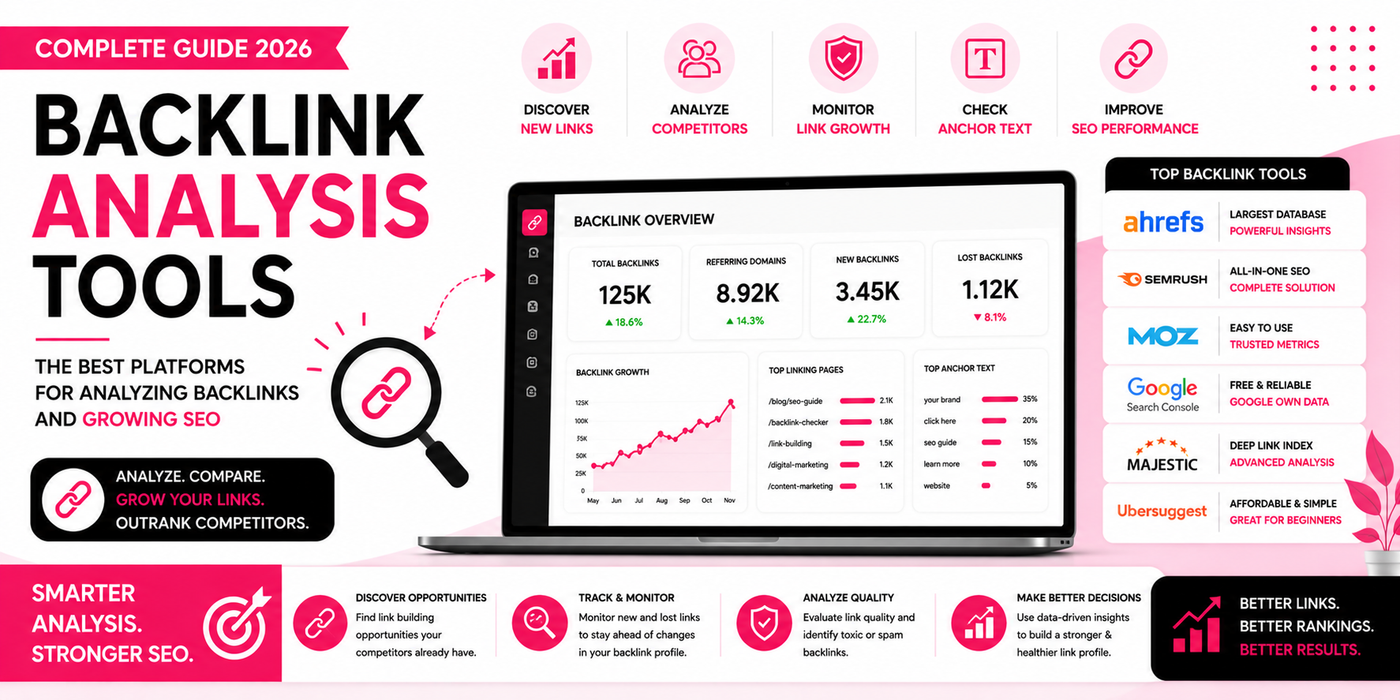
Backlinks remain one of the most important signals used to evaluate website authority and online visibility. However, collecting backlinks is only part of the process. Website owners also need reliable ways to analyze backlinks, monitor link growth, evaluate referring domains, and identify potential SEO opportunities.
According to research published by Ahrefs, pages with a higher number of referring domains generally attract more organic traffic than pages with fewer referring domains. Meanwhile, studies from Moz continue to highlight the relationship between high-quality backlinks and search visibility. As a result, backlink analysis has become a core component of modern SEO strategy rather than an optional activity.
The right backlink analysis tools can transform large amounts of data into actionable insights. Whether you're trying to monitor competitors, discover new link opportunities, evaluate backlink quality, or track SEO progress, backlink analysis software helps simplify the process and reveal opportunities that might otherwise remain hidden.
Table of Contents
- What Are Backlink Analysis Tools?
- Why Backlink Analysis Matters
- What Makes a Good Backlink Analysis Tool?
- Best Backlink Analysis Tools in 2026
- Ahrefs
- Semrush
- Moz Link Explorer
- Google Search Console
- Majestic
- Ubersuggest
- Backlink Tool Comparison
- Free vs Paid Backlink Analysis Tools
- Important Backlink Metrics Explained
- Common Backlink Analysis Mistakes
- FAQs
- Final Thoughts
What Are Backlink Analysis Tools?
Backlink analysis tools are software platforms designed to show which websites link to your content. These tools crawl the web, collect backlink information, and organize the data into reports that help website owners understand the strength and structure of their backlink profiles.
Most backlink analysis tools provide insights into:
- Referring domains
- Total backlinks
- New backlinks
- Lost backlinks
- Anchor text distribution
- Competitor backlink profiles
- Link quality indicators
- Historical backlink growth
Without backlink analysis software, manually tracking backlinks across hundreds or thousands of websites would be nearly impossible. These tools help transform complex SEO data into reports that support smarter decision-making.
Why Backlink Analysis Matters
Publishing content is important, but understanding how other websites interact with that content provides additional context for SEO decisions.
Backlink analysis helps businesses identify:
- Which content attracts backlinks
- Which websites reference their content
- How competitors earn backlinks
- Where link-building opportunities exist
- Potential risks within backlink profiles
Research from Ahrefs has found that pages ranking highly in search results often have significantly more referring domains than lower-ranking pages. While backlinks are only one component of SEO, understanding backlink patterns can help businesses uncover why certain pages perform better than others.
| Benefit | Why It Matters |
|---|---|
| Monitor Link Growth | Tracks backlink acquisition over time |
| Competitor Research | Reveals link-building opportunities |
| Link Quality Analysis | Evaluates backlink strength |
| Spam Detection | Identifies potentially harmful links |
| Content Insights | Shows which pages attract links |
Review backlink reports monthly instead of daily. Backlink growth usually occurs gradually, and monthly reviews provide enough data to identify meaningful trends without becoming distracted by normal fluctuations.
What Makes a Good Backlink Analysis Tool?
Not every backlink checker offers the same capabilities.
Some platforms specialize almost entirely in backlink intelligence, while others combine backlink analysis with keyword research, technical SEO, content marketing, and rank tracking features.
When evaluating backlink tools, several characteristics consistently matter.
Large and Frequently Updated Databases
A backlink tool is only as useful as the data it collects.
Platforms with larger databases generally discover backlinks more quickly and provide broader coverage across the web. As a result, many SEO professionals prioritize tools that continuously crawl billions of webpages.
Referring Domain Analysis
Strong backlink analysis tools help users understand not only how many backlinks exist but also where those links originate.
Because referring domains often provide a clearer picture of authority than raw backlink counts, this feature remains one of the most important parts of backlink analysis.
Competitor Backlink Research
Competitor analysis can reveal websites that regularly link to content within your industry.
By studying competitor backlinks, businesses can uncover:
- Potential outreach opportunities
- Industry publications
- Guest posting opportunities
- Resource page placements
- Content gaps
New and Lost Link Tracking
Backlink profiles change constantly.
Monitoring new backlinks alongside lost links helps businesses understand whether authority is growing, declining, or remaining stable over time.
Best Backlink Analysis Tools in 2026
Several platforms dominate the backlink analysis industry. Each tool offers unique strengths depending on budget, experience level, and SEO objectives.
1. Ahrefs
Ahrefs remains one of the most popular backlink analysis tools available.
Its extensive backlink database and competitor research capabilities have made it a favorite among SEO professionals worldwide.
Features include:
- Referring domain analysis
- Lost link tracking
- New backlink monitoring
- Anchor text reports
- Competitor backlink research
- Historical backlink growth
According to information published by Ahrefs, the company maintains one of the largest backlink indexes in the SEO industry, making it particularly valuable for advanced backlink research.
2. Semrush
Semrush combines backlink analysis with broader SEO functionality.
In addition to backlink research, users can access:
- Keyword research
- Rank tracking
- Site audits
- Content marketing tools
- Competitor analysis
Its backlink audit functionality is especially useful for evaluating backlink quality and identifying suspicious links.
Businesses looking for a comprehensive SEO platform often choose Semrush because it consolidates multiple SEO workflows within a single interface.
3. Moz Link Explorer
Moz focuses on making SEO concepts more accessible.
Its Link Explorer platform provides:
- Backlink reports
- Domain Authority metrics
- Spam score evaluations
- Referring domain analysis
- Anchor text reports
Many beginners appreciate Moz because its reporting interface feels less overwhelming than some advanced platforms.
As a result, Moz remains popular among bloggers, small businesses, and newer SEO practitioners.
4. Google Search Console
Google Search Console is one of the most valuable free backlink analysis tools available.
Unlike third-party platforms, Search Console provides data directly from Google's systems.
Users can review:
- Top linked pages
- Top linking websites
- Anchor text data
- Internal linking structures
Although it does not provide the depth of Ahrefs or Semrush, Search Console often serves as the foundation of many backlink monitoring workflows.
5. Majestic
Majestic specializes almost entirely in backlink intelligence.
Its most well-known features include:
- Trust Flow
- Citation Flow
- Link context analysis
- Referring domain reports
- Historical backlink indexes
Because of its heavy focus on backlinks, Majestic often appeals to dedicated link-building specialists and advanced SEO professionals.
6. Ubersuggest
Ubersuggest offers a more affordable entry point into backlink analysis.
Features include:
- Backlink reports
- Competitor analysis
- Referring domain tracking
- Keyword research
- SEO audits
While its database may not match the scale of larger platforms, many small businesses find it sufficient for everyday SEO needs.
Backlink Tool Comparison
| Tool | Best For | Beginner Friendly | Pricing |
|---|---|---|---|
| Ahrefs | Deep backlink research | Medium | High |
| Semrush | All-in-one SEO | Medium | High |
| Moz | Simplicity and accessibility | High | Medium |
| Google Search Console | Free monitoring | High | Free |
| Majestic | Advanced link analysis | Low | Medium |
| Ubersuggest | Budget-friendly SEO | High | Low |
Free vs Paid Backlink Analysis Tools
Many businesses begin with free tools before investing in premium platforms.
Advantages of Free Tools
- Lower cost
- Suitable for beginners
- Basic backlink visibility
- Good for smaller websites
Advantages of Paid Tools
- Larger backlink databases
- Competitor analysis
- Historical reporting
- Advanced filtering
- More frequent updates
Businesses pursuing aggressive SEO growth often discover that advanced competitor insights and larger backlink indexes justify the investment in premium tools.
Before purchasing a backlink analysis platform, take advantage of free trials whenever possible. Testing several tools can help identify which interface, workflow, and reporting style best match your needs.
Important Backlink Metrics Explained
Referring Domains
Referring domains represent unique websites linking to your content.
Many SEO professionals consider referring domain growth more important than total backlink counts because it reflects broader industry recognition.
Research published by Ahrefs consistently shows strong relationships between referring domain growth and search visibility.
Anchor Text
Anchor text refers to the clickable text within hyperlinks.
Natural anchor text distributions typically include:
- Brand names
- URLs
- Page titles
- Natural phrases
- Keyword variations
Domain Authority
Domain Authority is a metric created by Moz that estimates the relative strength of a website's backlink profile.
Although widely used, it should be viewed as an indicator rather than a direct Google ranking factor.
Toxic Links
Some backlink analysis platforms attempt to identify potentially harmful backlinks.
These links may originate from:
- Spam-heavy websites
- Low-quality directories
- Link schemes
- Automated networks
Monitoring backlink quality helps businesses maintain healthier backlink profiles over time.
Common Backlink Analysis Mistakes
Focusing Only on Backlink Counts
Large backlink numbers do not automatically indicate stronger SEO performance.
Relevance, authority, and audience alignment often matter more than raw quantities.
Ignoring Referring Domains
Referring domain growth frequently provides a clearer picture of authority development.
Using Only One Tool
Because backlink databases differ between platforms, reports frequently vary.
Comparing multiple sources often provides a more complete understanding of backlink performance.
Ignoring Historical Trends
Backlink growth patterns over time often reveal more useful insights than isolated reports.

